BALLOT MEASURES
GUIDE
Ballot Measures Guide
2026 Ballot Measures Guide
Local measures
City of Boulder
Erie
Lafayette
Longmont
Louisville
Niwot
Special district measures
Statewide measures
Amendment 81: Local Law Enforcement Cooperation with ICE
In brief, this initiative would require state or local law enforcement agencies and attorneys to notify the federal Department of Homeland Security regarding detained persons in certain circumstances, if the person is either undocumented or it can’t be proven that they’re in the United States legally.
This is a proposed amendment to the Colorado Constitution, and would need 55% of the vote (plus at least one) to pass.
The Colorado Democratic Party and Boulder County Democratic Party have both formally OPPOSED Amendment 81.
What Would Amendment 81 Do?
The text to Amendment 81 (formerly known as Initiative 95) is relatively short. In a nutshell, passing it would:
Require Colorado law enforcement and/or attorneys to notify the federal Department of Homeland Security (DHS) within 72 hours of a person being charged with certain crimes (see next bullet point), if the person is either actually in the country without documentation or can’t be proven to be in the country legally.
The person must also have been charged with a crime of violence, or convicted of a prior felony.
Colorado law enforcement would be required to make a “reasonable effort” to determine if such a person is legally present in the United States.
Passing Amendment 81 would also create a completely new Section 17 to the Colorado Constitution’s Article 18. This article is titled “Miscellaneous” and seems to be sort of a catch-all of random sections, including sections about things like lotteries, liquor, hunting and more.
One major consideration that’s not in the initiative’s text is that immigration is a federal responsibility, and according to Congress.gov, “Long-standing Supreme Court precedent recognizes Congress as having plenary power over immigration.” Currently, a number of sections in Colorado statutes have language expressly forbidding certain types of cooperation between state/local and federal authorities related to immigration status. For reference, the state legislature has passed bills such as HB 19-1124 and SB 25-276.
Immigration policy is currently not in the Colorado Constitution at all. However, this Constitutional amendment would supersede conflicting state statutes if Amendment 81 passes.
The most current fiscal note for Amendment 81 predicts only about $60,000 in state expense, mostly for digital system updates. It also notes that the state might lose some economic activity if people not in the country legally are deported, but there could also be economic benefits if crime is reduced.
Why Was It Proposed?
Amendment 81 is sponsored by Michael Fields and Suzanne Taheri, both associated with the conservative organization Advance Colorado – Fields as its president and Taheri as a legal counsel. Advance has supported several other ballot measures in recent years that might be considered “tough on crime,” and Amendment 81 appears to be another that could lead to tougher enforcement if it’s adopted.
Kristi Burton Brown, a vice president with Advance, is quoted on Ballotpedia saying “This really isn't a controversial issue when you narrow in on violent criminals and repeat felons and saying it's pretty common sense that no one wants them free on our streets..."
Opposition Points
Amendment 81 was cleared for the ballot on January 23, 2026, before the behavior of ICE under the Trump administration became extremely apparent and controversial. Too many things have happened to list here, but in short, people have been detained without warrants, deported or detained despite being citizens, and there have been reports of fatalities, brutality, and/or inhumane treatment during arrests or detentions. Passing Amendment 81 would almost certainly increase the numbers of people contacted by ICE, and the risks to these individuals seem far more severe than they were during past administrations.
For more, see the legal analysis at the American Immigration Council.
The Colorado League of Women Voters has formally opposed this initiative, including for these reasons:
A person who is a lawful resident or U.S. citizen could be subjected to this provision in error. Some errors could be caused by racial profiling.
If a person is charged with a crime of violence, that does not mean they are guilty. The person is entitled to due process protections, including the presumption of innocence until proven guilty.
Law enforcement agencies across Colorado differ about a number of issues including immigration policy, often on partisan political lines. Some reports generally suggest that law enforcement agencies could face increased workload or deadline pressure if Amendment 81 passes.
Extra Reading
Proponents for Initiative 95 (now Amendment 81) may have engaged in deceptive practices while attempting to get people in Boulder County to sign its petition.
For More Information
Text of Amendment 81: https://www.coloradosos.gov/pubs/elections/Initiatives/titleBoard/filings/2025-2026/95Final.pdf
State Legislative Council Fiscal Notes: https://leg.colorado.gov/initiatives/law-enforcement-reporting-requirements-to-federal-authorities-95
Amendment 82: Constitutional right to pollute
Passing Colorado Amendment 82 would amend the Colorado Constitution to add a “right to purchase” natural gas in Colorado along with a “right to sell”. It would need 55% (plus one) of the vote to pass. The Secretary of State’s office announced on Aug. 6 that proponents had gathered enough valid petition signatures to put Amendment 82 (formerly known as Initiative 177) on the 2026 ballot.
The Colorado Democratic Party and Boulder County Democratic Party have both formally OPPOSED this ballot measure.
This initiative is short enough to post in full here:
SECTION 1. In the constitution of the state of Colorado, add section 17 to article XVIII as follows:
Section 17. Right to natural gas.
(1) CONSUMERS HAVE THE RIGHT TO PURCHASE NATURAL GAS FOR COOKING OR HEATING IN HOMES OR BUSINESSES THROUGHOUT THE STATE.
(2) DISTRIBUTORS AND UTILITIES HAVE THE RIGHT TO SELL NATURAL GAS FOR HOMES OR BUSINESSES.
What Would It Do?
Beyond enshrining the rights to purchase and sell natural gas in the state Constitution, it might be tough to really tell what Amendment 82 would do in practice until there are legal challenges. It does seem likely that it would prevent state or local governments from passing full or partial bans, unless they’re OK with testing them in court against language that would be in the Constitution if Amendment 82 passes.
There are no legal penalties written into Amendment 82 for attempts to prevent natural gas sales or purchases. There is no language defining, modifying, or placing conditions on the word “right”, so it seems as if the proponents’ intent is to create unconditional rights.
Some media reports and press releases suggest passing Amendment 82 could put governments that attempt to restrict natural gas sales or purchases at risk of lawsuits. The striking down of local ordinances seems possible. It seems possible that Amendment 82 might even make ordinances already in place invalid, or unenforceable. There is nothing in Amendment 82 language that “grandfathers” any existing laws.
Why Was It Proposed?
Amendment 82 is sponsored by Michael Fields and Steven Ward, and the organization Advance Colorado is listed under both of their names. Advance Colorado often sponsors and/or supports conservative initiatives, and has used dark money to fund advocacy for these ballot measures.
Some local governments in Colorado have proposed restrictions on natural gas in their communities. Crested Butte banned it for all new construction in 2022, Lafayette requires all-electric systems in most new construction, while Boulder and Denver have updated their building codes to discourage gas use in new construction.
Fields has released media statements saying allowing gas could save consumers money on electrical bills compared to other sources. Also, Advance Colorado has released a fairly lengthy report partially about why they believe the use and sales of natural gas should continue in Colorado: https://www.advancecolorado.org/wp-content/uploads/2026/04/Natural-Gas-Clean-Affordable-Reliable-Energy-for-Colorado.pdf
This is a general observation and not from Fields or Advance, but Colorado is a significant natural gas producer and user, so a reduction in gas sales or use could have economic impacts.
Opposition Positions
Natural gas extraction releases methane into the environment, one of the greenhouse gases linked to climate change. Gas is often obtained through fracking, which can pollute the air, use large amounts of water, and disturb the subsurface geology in a way that might even contribute to earthquakes. Indoor gas use can introduce chemicals like benzene into the home environment.
Environmental organizations are likely to oppose this initiative for the reasons above and because it seems to put an absolute right to gas in the Constitution. Though it hasn’t been tested in court yet, it seems as if even small updates to building codes having to do with natural gas might land a local or state government in court. Since Amendment 82 is a Constitutional amendment, it might be difficult or impossible for the state government to pass a statute that would limit gas use, since the Constitution supersedes statutes.
“Renewable energy is the fastest and cheapest energy to deploy, so this cynical attempt to lock fossil fuels into the state constitution would leave Coloradans with higher utility bills and dirty air…” said Kelly Nordini, CEO of Conservation Colorado in a March 2026 press release.
Opponent Points
This initiative should not go into the state Constitution
There might be perfectly good reasons for the state or local governments to pass ordinances to regulate natural gas, whether they’re environmental or economic in scope
The ballot measure could be seen as very vague – what constitutes a right to use natural gas? What happens if a local government passes an ordinance anyway?
The full impact of natural gas is perhaps not known yet, and it might have impacts on human health or a number of parts of the environment.
Links to More Information
Amendment 82 text: https://www.coloradosos.gov/pubs/elections/Initiatives/titleBoard/filings/2025-2026/177Final.pdf
Colorado Legislative Council fiscal analysis: https://leg.colorado.gov/initiative_files/3089/download
Advance Colorado webpage on affordability (includes a bit about natural gas): https://www.advancecolorado.org/institute/affordability/
Media
Amendment 83: Special interest control over natural resources
Passing Amendment 83 would establish in the Colorado Constitution a new constitutional right to hunt and fish. However, there would be exceptions to this right, including not allowing hunting or fishing of endangered or protected species, which is currently against the law and would continue to be against the law if 83 passes.
Since it’s a Constitutional amendment, it would require 55% (plus one) of the vote or more to pass.
The Boulder County Democratic Party has formally OPPOSED this ballot measure.
Why?
The designated representatives for Amendment 83 are Suzanne Taheri and Steven Ward, both who have been associated with the conservative dark money group Advance Colorado. Also, the pro-hunting organization Coloradans for Responsible Wildlife Management (CRWM) is among the initiative’s supporters.
Readers might find interesting the following brief about right-wing ties to not just Amendment 83, but also right-to-hunt amendments in other states: https://wildlifeforall.us/far-right-network-behind-initiative-302/
In recent years, there have been citizen initiatives and state bills proposed in the legislature that hunting advocates and to some extent rural communities did not support. For example, Proposition 127 in 2024 would have banned recreational mountain lion hunting, although it did not pass. Whether true or not, there has been concern in hunting circles that proponents would keep trying to pass hunting regulation measures, by initiative or in the legislature, and CRWM has said on its website that Amendment 83 was an attempt to protect hunting and fishing in Colorado “before the next attack comes.”
Could the Initiative Language Lead to Litigation?
Here is the entire section of language that would go into the Constitution if Amendment 83 passes:
(1) THERE IS ESTABLISHED A RIGHT OF THE PEOPLE OF COLORADO TO HUNT, FISH, AND TAKE FISH AND WILDLIFE. THE RIGHT INCLUDES HUNTING, FISHING, AND HARVESTING FISH AND WILDLIFE BY THE USE OF TRADITIONAL METHODS. THE RIGHT APPLIES TO ALL SPECIES OF FISH AND WILDLIFE MANAGED BY THE STATE EXCEPT NONGAME SPECIES, ENDANGERED SPECIES, OR ANY SPECIES THAT IS ILLEGAL TO HUNT UNDER FEDERAL LAW.
(2) THE POLICY OF THE STATE OF COLORADO IS THAT HUNTING AND FISHING ARE THE PREFERRED MEANS OF RESPONSIBLY MANAGING FISH AND WILDLIFE POPULATIONS.
(3) THIS SECTION IS NOT INTENDED TO AUTHORIZE TRESPASS UPON PRIVATE PROPERTY OR TO MODIFY ANY PROVISION OF STATUTES RELATING TO TRESPASS OR PROPERTY RIGHTS.
(4) THIS SECTION DOES NOT LIMIT THE AUTHORITY OF AN AGENCY OF THE STATE OF COLORADO OR THE GENERAL ASSEMBLY TO REGULATE HUNTING, FISHING, AND WILDLIFE MANAGEMENT IF THE LAW IS NECESSARY FOR SOUND SCIENTIFIC WILDLIFE CONSERVATION AND MANAGEMENT, PUBLIC SAFETY, OR TO PRESERVE THE FUTURE OF HUNTING AND FISHING OPPORTUNITIES FOR ALL SPECIES STATEWIDE.
Some people might question a few parts of this language:
What constitutes “traditional methods?” Could these include methods that were once common but have since been banned?
Do Coloradans really want a statement that hunting and fishing are the “preferred means” of managing wildlife in our Constitution?
Who decides what is “sound science,” especially if there might be conflicting scientific opinions on an issue?
Would this amendment preclude citizen initiatives that regulate hunting or fishing? The language in paragraph (4) seems to allow wildlife bills or rules from the state legislature or state agencies that meet the initiative’s standards, but it does not specifically mention the citizen initiative.
When clauses in a ballot measure aren’t well-defined, it is possible that issues might ultimately need to be decided in the courts.
Some Practices Would Still Be Prohibited
Readers should notice in the initiative language paragraph (1) that hunting of endangered or federally protected species would still be prohibited even if Amendment 83 passes. The same goes for “non-game” species, like certain reptiles, rodents, or birds of prey, which are defined in Colorado codes.
Amendment 83 Opponent Points
Hunting and fishing are both well-covered in Colorado statutes and codes, so putting this in the Constitution is unnecessary
The language could be seen as vague in places, which might mean differences in interpretation might lead to litigation. This could be a good reason to keep 83 out of the Constitution.
Links to More Information
Colorado Legislative Council webpage on 83, including info that will go out in the Blue Book: https://leg.colorado.gov/ballots/constitutional-right-to-hunt-and-fish-2
Amendment 83 text: https://www.coloradosos.gov/pubs/elections/Initiatives/titleBoard/filings/2025-2026/302Final.pdf
Colorado Hunters and Anglers for Sensible Wildlife Conservation (opponents against 83): https://www.coloradohuntersandanglers.com/
Keep Colorado’s Voice (opponents against 83): https://keepcoloradosvoice.com/
Amendment 84: Barriers to mail voting
Amendment 84 seeks to require voters to disclose personally identifying information when returning mail ballots across the state. It would require ballots not including that information – like the last 4 digits of the voter’s social security number or full driver's license number – to be rejected with an opportunity for the voter to “cure” their ballot by providing that information in person to the county clerk’s office.
This proposal is a Constitutional amendment, and would need 55% of the vote (plus at least one) to pass.
The Colorado Democratic Party and Boulder County Democratic Party have both formally OPPOSED this ballot measure.
Why?
This initiative was placed on the ballot through the efforts of the Colorado Voter Trust Initiative, a state issue committee funded by the dark money group Coalition for American Prosperity and Growth. It was filed by 2 Republican officials, Chuck Broerman of El Paso County and Suzanne Taheri of the conservative law firm West Group.
The claimed goal is to increase trust in elections, however consistent with other conservative groups across the country, the primary effect of the initiative if it were to pass would be to increase the complexity of the voting process, which might actually disenfranchise perfectly eligible voters.
Proponent Points
None worth dignifying.
Opponent Points
The information the initiative would require to be placed on ballot is duplicative of information already submitted by the voter when registering.
Adding this sensitive personally identifying information to the ballot increases the risk of identity theft for citizens simply exercising their rights.
This initiative would disproportionately impact those most likely to make a mistake through honest error and those marginal voters who may have been unlikely to vote in the first place, and therefore the least likely to put in the time to cure their ballot.
Links to More Information
Text of initiative: https://www.coloradosos.gov/pubs/elections/Initiatives/titleBoard/filings/2025-2026/362Final.pdf
League of Women Voters of Colorado: https://lwvcolorado.org/content.aspx?page_id=22&club_id=314195&module_id=747768
Defend Our Ballots, an opponent campaign: https://defendourballots.com/
Amendment 85: Limiting information on ballot questions
Amendment 85 (formerly known as Initiative 234) would amend the Colorado Constitution to say that all ballot questions should be written at an 8th grade reading level. It would also prohibit the state from mandating language to include with ballot measures that would be at above the 8th grade reading level.
Since it’s a proposed Constitutional amendment, it would require 55% (plus one) of the vote to pass.
The Colorado Democratic Party and Boulder County Democratic Party have both formally OPPOSED this ballot measure.
Complete Amendment 85 language:
SECTION 1. In Colorado Constitution Article V, Section 1, add (5.6) as follows:
(5.6) BALLOT QUESTIONS SHALL BE IN PLAIN LANGUAGE AT NO MORE THAN AN EIGHTH-GRADE READING LEVEL. NO STATUTE MAY INTERFERE WITH THIS PROVISION BY MANDATING LANGUAGE PRECEDING, FOLLOWING, OR IN A BALLOT TITLE OF AN INITIATIVE.
Why?
Ballot titles that people see on their ballot can be confusing. They’re typically written to capture the main legal points of a ballot measure, and don’t go into deep impacts or context. Writing the titles at an 8th-grade level can help ensure that most people might be able to understand what they’re voting on.
While voters probably “should” use other sources of information, like the state Blue Book or campaign websites, there are people who won’t search deeper and just vote based on what’s printed on their ballot.
What Does the Second Sentence Mean?
It is possible for initiatives or state statutes to mandate that certain types of information appear on the ballot. For example, TABOR requires tax or bond ballot titles to begin with the estimated amount of money taxpayers would provide. Recently, initiatives or bills have called for other types of information, including Proposition GG which calls for tax tables to be provided with income tax measures, and HB 21-1321 which requires information about how measures might impact state or local government revenue.
The second sentence says Amendment 85 would not allow laws or initiatives that “INTERFERE WITH THIS PROVISION,” seemingly referencing the first sentence about 8th-grade reading level. The state Blue Book interprets this to mean it would prohibit laws “that may interfere with the plain language requirement.”
Opponents of Amendment 85, like the Bell Policy Center, say this provision might keep voters from seeing title language that might help them make a more-informed voting decision.
Are There Readability Laws Now?
The State of Colorado has a “Title Board” that sets title language for initiatives. There are state laws in place requiring the Title Board to consider if title language might be confusing. Also, the state legislature passed HB 26-1320 this year, which requires “accessible language” but does not mandate any specific grade-level readability.
Amendment 85 Opponent Points:
The second sentence in Amendment 85 might prevent people from getting a fuller range of information they might need to cast a well-informed ballot.
Links to Additional Information:
Amendment 85 text: https://www.coloradosos.gov/pubs/elections/Initiatives/titleBoard/filings/2025-2026/234Final.pdf
State ballot analysis page (scroll down to find Amendment 85): https://leg.colorado.gov/initiatives/ballot-analysis-drafts-and-deadlines
Amendment 86: Preventing fair districts
Functionally, passing Amendment 86 would prevent Colorado from using new Congressional district maps in 2028, unless both the Colorado Independent Redistricting Commission and the Colorado Supreme Court approve a plan.
This is a proposed amendment to the Colorado Constitution, and would need 55% (plus one) of the vote to pass.
The Colorado Democratic Party and Boulder County Democratic Party have both formally OPPOSED this ballot measure.
Why?
Very briefly, the State of Texas touched off national redistricting wars in 2025 by creating new maps, which they hoped would deliver five U.S. House seats for Republicans. California eventually ran a ballot measure allowing them to do redistricting that would favor Democrats, and a number of other states took on their own processes – probably all of them for some type of partisan advantage.
A group in Colorado known as Coloradans for a Level Playing Field drafted several initiatives that might have helped Colorado deliver more seats for Democrats. Knowing this, conservative interests drafted two initiatives that would have prevented Colorado from doing this, and one of them was what is now Amendment 86. The designated representatives are Suzanne Taheri and Elizabeth Caven, both with the conservative organization Advance Colorado listed after their names on the Secretary of State’s webpage for this initiative.
Typically, redistricting only happens once every 10 years, after the U.S. Census, and districts normally stay the same until the next Census. Until 2025, “mid-decade redistricting” was quite rare.
What Would the Initiative Do?
Those who try to read the initiative might see that it’s 14 pages long, but only one small section really matters. Colorado voters put language defining rules and practices of the Colorado Independent Redistricting Commission into the state constitution in 2018, and Amendment 86 keeps all of the language from the 2018 measure – but adds the following:
(1.5) UPON ADOPTION AND APPROVAL OF THE FINAL PLAN, NO PLAN MAY BE MODIFIED FOR THE 2028 CONGRESSIONAL ELECTION OR THEREAFTER EXCEPT WITH THE APPROVAL OF THE CONGRESSIONAL COMMISSION AND ADOPTION BY THE COLORADO SUPREME COURT. IN REVIEWING THE PLAN, THE COMMISSION MUST HOLD AT LEAST THREE PUBLIC MEETINGS AND MUST NOT ADOPT ANY PLAN THAT HAS THE EFFECT OF DIVIDING COMMUNITIES OF INTEREST OR PURPOSEFULLY FAVORING ONE POLITICAL PARTY.
Functionally, the language doesn’t mention any specific party, but only Democrats or left-wing supporters would be likely to run a measure in 2028.
Amendment 86 Opponent Points
Nationwide, certain “red states” are doing redistricting with the intent of possibly making sure Republicans keep control of the House. This initiative could unfairly prevent Colorado from attempting to help balance out Republican efforts.
Links to More Information
Legislative Council page on Amendment 86: https://leg.colorado.gov/ballots/requirements-for-off-cycle-congressional-redistricting-2
Amendment 86 text: https://www.coloradosos.gov/pubs/elections/Initiatives/titleBoard/filings/2025-2026/256FinalCorrected.pdf
Amendment 87: Fairer taxes for all
Passing Amendment 87 (formerly known as Initiative 195) would create a graduated State of Colorado income tax system, with higher-income tiers paying higher overall rates than lower-income tiers. Currently, Colorado’s income is taxed at a flat rate.
This initiative would both amend the Colorado Constitution and Colorado Revised Code, but since it only amends the Constitution by repealing 14 words, it would only need a simple majority of voters to pass.
The Colorado Democratic Party and Boulder County Democratic Party have both formally ENDORSED this ballot measure.
Why?
Per Amendment 87 language, there’s an economic fairness issue in that the top 1% of Coloradans pay about 7% of their income in state and local taxes, while the 60% of Coloradans between $25,000 and $150,000 pay 9–10%.
The graduated income tax proposal could help reduce the inequality, and would reduce income rates for about 97% of Coloradans if it passes. About 27 other states already have some type of graduated income tax system. Also, the revenue would be used on programs Colorado families might benefit from, including healthcare and education.
Constitutional Change
Currently, Colorado has a flat income tax rate because of language in the Taxpayer’s Bill of Rights (TABOR), which is in the Colorado Constitution. Amendment 87 would strike a few words in TABOR to remove the flat-tax language, as shown below:
Any income tax law change after July 1, 1992 shall also require all taxable net income to be taxed at one rate, excluding refund tax credits or voter-approved tax credits, with no added tax or surcharge.
The Graduated Tax Rates
Colorado income tax rates are based on a taxpayer’s federal taxable income, and the current flat rate is 4.41%. The rates under Amendment 87 would be effective for individual/family taxpayers and for C corporations. If 87 passes, all tiers would pay the same rate on the first $25,000, then anyone above $25,000 would be subject to the rates shown below on the portion of income they take in.
Basically, a person earning $1 million or more would pay each of the rates shown below on the portion of their income below $1 million:
$25,000 or less (federal taxable income): 3.71%
$25,000 to $100,000: 4.21% on the portion between $25,000 and $100,000
$100,000 to $500,000: 4.41% on the portion between $100,000 and $500,000.
$500,000 to $750,000: 7.41% on the portion between $500,000 and $750,000.
$750,000 to $1 million: 7.91% on the portion between $750,000 and $1 million.
For $1 million and up: 8.41% on the portion that’s $1 million and up.
How Would the Money Be Used?
State fiscal analyses suggest Amendment 87 might bring in about $2 billion in its first year, which under the initiative’s language would go to the following categories:
K-12 Education: including increasing access to career and technical education and improving teacher pay.
Healthcare: including family affordability, replacing lost Medicaid funding, care for older adults and people with disabilities, rural healthcare, behavioral healthcare, primary care, and nutritious food programs.
Early Childcare and Education: including family affordability, better pay for the workforce, and improving access to programs.
One Complicating Factor: Proposition 136
Knowing that a graduated income tax proposal might be on this year’s ballot, people associated with the conservative organization Advance Colorado got Proposition 136 on the ballot. This measure would cap Colorado’s income tax rate at 4.4% for everybody.
Normally, when competing measures are on the same ballot and both get above 50% of the vote, the initiative with the most votes takes effect, but there are some questions around what might happen if they both get more than 50% of the vote, which might need to be settled in the courts or legislature.
Amendment 87 Proponent Points:
Wealthier Coloradans can probably afford the necessities of life, while poorer Coloradans might need to sacrifice. The graduated tax rates would give poorer Coloradans a tax break that they might be able to use on the basics.
The revenue from Amendment 87 would help better fund state services that families would benefit from, including healthcare and education.
Links to More Information
Proponent website: https://protectcoloradosfuture.com/
Colorado Legislative Council webpage: https://leg.colorado.gov/ballots/graduated-income-tax-2
Initiative text: https://www.coloradosos.gov/pubs/elections/Initiatives/titleBoard/filings/2025-2026/195Final.pdf
Proposition NN: Improve K–12 education funding
Proposition NN, called, “State Public K-12 Education Funding,” would allow TABOR caps to be exceeded for ten years to support increased funding for K–12 public education and other services to support children. Some of the funds will be used to reimburse local government for certain property tax exemptions.
The Colorado General Assembly put NN on the ballot by passing Senate Bill 26-135. Prop NN is a statutory measure, not Constitutional, and would pass with 50% plus one of the vote in November.
Both the Boulder County Democratic Party and the Colorado Democratic party have formally ENDORSED this measure.
Here are a few key statistical points about NN:
Would provide up to $136 million the current partial fiscal year (FY 2026–27) and $927 million next full fiscal year (FY 2027–28). The program will continue in perpetuity with expenditures rising with increases in the TABOR cap set by Amendment C.
Would decrease TABOR refunds by the same amounts, i.e., $136 million in FY ‘26–27, $927 million in FY ‘27–28, and increasing amounts in fiscal years after ‘27–28.
The expenditures are estimated to be as follows in FY ’27-28:
$136.1 million for property tax reimbursements. This will reimburse local governments for the homestead exemption, which reduces property taxes for certain seniors, veterans with a disability, and Gold Star spouses.
Increase funding for K–12 education by $382.2 million.
Of this total amount, $219.1 million comes from a classification called the “Positive Factor” which is 2% of education funding in ’26–27; and $163.1 million comes from the General Fund.
The money from the Positive Fund must be used to increase teacher pay and retention, smaller class sizes, and access to career and technical courses.
The money from the Positive Factor is distributed to school districts across the state based on allocations specified in the initiative. Boulder Valley School District and St. Vrain will get respectively, 3.05% and 3.51% of the total.
The distribution to schools from the General Fund money will be decided by the Legislature.
451.4 million must be spent on the “Children’s Account.” This account puts a priority on child care, pre-school, and other programs that prepare children to attend school.
All of the $136.1 million in FY ‘26–27 will go to the Children’s Account.
TABOR refunds would be reduced by $969.7 million in FY 27-28. The reductions in refunds will come from:
Property Tax Refunds is reduced by $212.2 million;
Income Tax Rate Reduction is reduced by $354.0 million; and
Six-tier Sales Tax Refund (which allocates refunds based on income levels) is reduced by $403.5 million.
In FY ‘26–27, the $136.1 million would all come from reduced property tax refunds.
According to House Democrats, Colorado ranks 40th in the US in teacher pay and retention and underfunds education by $4600/student.
Proponent Points
Increases spending for K-12 education and to help children prepare for school.
Colorado schools and pre-school programs need more funding to catch up with other states.
Pays for required Homestead Property Tax Exemption.
Links for More Information
Fiscal Note. Legislative Council Staff. “SB 26-135: STATE PUBLIC K-12 EDUCATION FUNDING.” March 10, 2026. https://leg.colorado.gov/bill_files/113088/download.
Fiscal Note. Legislative Council Staff. “SB 26-135: STATE PUBLIC K-12 EDUCATION FUNDING.” May 11, 2026. https://leg.colorado.gov/bill_files/116264/download
Colorado House Democrats. May 26, 2026. “Bill to Boost Funding for K-12 Schools Passes House.” https://www.cohousedems.com/news/bill-to-boost-funding-for-k-12-schools-passes-house
Colorado Education Association. March 5, 2026. “Lawmakers Introduce Bill to Refer School Funding Measure to Voters to Make Critically Needed Investments in Education.” https://coloradoea.org/news-updates/lawmakers-introduce-bill-to-refer-school-funding-measure-to-voters-to-make-critically-needed-investments-in-education/
Proposition 132: Private prison money grab
If passed, Proposition 132 would update State of Colorado laws involving fentanyl possession and dealing, largely to increase existing criminal charges and penalties. The initiative includes penalties for other substances, but fentanyl is getting the most recognition at this time so “fentanyl” is being used here for brevity. It’s a statutory measure, and would pass with “50% +1” or more of the vote, a simple majority.
The Colorado Democratic Party and Boulder County Democratic Party have both formally OPPOSED this ballot measure.
What Would Proposition 132 Do?
The initiative would mostly revise two major sections of Colorado Revised Statutes that were updated in 2022 via HB 22-1326: CRS 18-18-405 and CRS 18-18-403.5. There are other sections of CRS that would be revised, but these are the two most substantial.
For top-level points from a long initiative, passing Prop 132 would change state law by:
Making distribution, manufacturing, dispensing, or sale of synthetic opioids a level 1 drug felony. This would increase charges under current law, under which crimes involving 4-50 grams of fentanyl are level 2 felonies, and 4 grams or less are level 3 felonies.
Making the possession of any amount of fentanyl a felony – level 3 for possession of 1–4 grams, or level 4 plus mandated drug treatment for less than a gram.
Removing a “good Samaritan” provision from current law, which provides immunity from criminal prosecution for the proximate cause of death if the individual reports the overdose to authorities.
Increasing sentencing for all level 1 drug felonies involving synthetic opiates to 12–32 years, more than current law which is 8–32 years unless crimes involving opioids contribute to fatalities.
Why was it proposed?
Proposition 132 is co-sponsored by Michael Fields and Suzanne Taheri, conservative political operatives who are associated with the organization Advance Colorado – Fields as its President and Taheri as a legal counsel.
Fentanyl is a very powerful opioid that is used responsibly in medical settings, but it can be extremely dangerous if used in non-regulated settings or recreationally. Fentanyl overdoses started to get major nationwide publicity around 2013, but numbers continued spiking in the years to follow and began being considered a crisis.
The Colorado General Assembly passed a law in 2022 (HB 22-1326) a lengthy bill which updated fentanyl policies, and in a number of sections increased charges and penalties. But according to the Advance Colorado website, “In 2022, lawmakers attempted to change course and tighten penalties on fentanyl, but it simply hasn’t been enough.”
Per Colorado Department of Public Health and Environment, there were 108 Colorado fentanyl overdose deaths in 2018, but numbers increased to 540 in 2020, 920 in 2022, and 1,097 in 2023. They went down to 749 in 2024, the last year available on the CDPHE chart.
It’s probably not possible yet to say the decrease in 2024 signified a trend, or that tougher penalties were the reason for the decrease. The 2022 bill also included harm reduction policies and strategies that could have impacted overdose death statistics, such as supporting Narcan to treat overdoses and test strips to test substances for the presence of fentanyl. The conservative organization Common Sense Institute has since reported that synthetic opioid overdose deaths in Colorado started increasing again for the first half of 2025.
The Journal of American Medicine has released a study saying “Increasing criminal penalties for fentanyl possession (through HB 22-1326) was not associated with a positive or negative change in ODs in Colorado.” Obviously, this is just one study. Given that overdose deaths increased in 2023, decreased in 2024, and started increasing in 2025 under the same law, it seems like other factors might be at play beyond criminal penalties alone.
Opposition Points
The organization Colorado Criminal Justice Reform Coalition is among groups opposing Prop 132, in short because increasing charges and penalties would increase costs to the criminal justice system and could disproportionately harm lower-level users (as opposed to dealers and traffickers). Here’s a link to their webpage on Prop 132: https://www.ccjrc.org/fentanylballotmeasure
CCJRC cited a fiscal analysis done by the State of Colorado Legislative Council, which estimated that passing Prop 132 would have tangible impacts, including:
It could increase the state’s prison population by about 900 people per year.
Keeping one person in prison for a year costs about $68,000.
It’s possible new prison beds would be needed, which cost about $413,000 per bed.
Meanwhile, Prop 132 does not propose any new form of revenue, so the corrections system would need to find a way to pay for higher prison populations using existing revenue.
The fiscal analysis also says state expenditures would increase by about $850,000 in fiscal year 2026–27 (a half-year) if Prop 132 passes, and by $4.9 million in FY 2027–28 with possible similar amounts in the years following.
On social levels, CCJRC says this initiative could negatively impact younger Coloradans, including some who might not know they were in possession of a substance containing fentanyl, and subject them to mandatory prison sentences. Also, Vincent Atchity of Mental Health Colorado wrote a late 2025 opinion piece suggesting it’s more effective to focus on prevention programs and harm reduction, as opposed to just imposing harsher legal penalties.
It is also possible that the stricter charges and/or penalties could impact people of color. Per The Action Lab at the Center for Health Policy and Law: “Harsher penalties for fentanyl-related crimes, like those targeting other substances in the past, fail to reduce overdose deaths or disrupt supply chains. These penalties disproportionately affect people of color and have proven ineffective in curbing drug use.”
For More Information:
Prop 132 text: https://www.coloradosos.gov/pubs/elections/Initiatives/titleBoard/filings/2025-2026/85Final.pdf
Current law under HB 22-1326: https://leg.colorado.gov/bills/hb22-1326
Colorado Legislative Council fiscal note: https://leg.colorado.gov/initiative_files/305/download
Opponent website (CCJRC): https://www.ccjrc.org/fentanylballotmeasure
Media:
Colorado Sun opinion piece: https://coloradosun.com/2025/12/23/opinion-colorado-ballot-initiative-not-helping-addicitions/
Denver Post announces Initiative 85 (now called Prop 132) qualifies for ballot: https://www.denverpost.com/2025/12/15/initiative-fentanyl-felony-colorado-ballot/
Proposition 133: Sexual Trafficking of Minors Penalties
The Colorado Require Life in Prison for Human Trafficking of Minors Measure is on the 2026 ballot in Colorado as an initiated state statutory proposal. It was called Initiative 108 before becoming Proposition 133. It would pass with 50% (plus one) of the vote, a simple majority.
A “yes” vote supports requiring life in prison without parole for persons convicted of human trafficking of a minor for sexual servitude.
A “no” vote opposes this ballot initiative, keeping human trafficking of a minor for sexual servitude classified as a class 2 felony, punishable by 8 to 24 years in prison
What would Proposition 133 do?
The ballot initiative would require life in prison without parole or release for persons convicted of human trafficking a child for sexual servitude.
As of 2026, the crime human trafficking of a minor for sexual servitude was defined as:[1]
Selling or otherwise knowingly facilitating the commercial sexual activity involving a person under age 18 or
Knowingly advertising, offering, or selling travel services that facilitate commercial sexual activity involving a person under age 18.
The ballot initiative would add a third element to this definition: knowingly exchanging anything of monetary value to buy or sell sexual activity with a person under age 18.
The ballot initiative would change the offense from a class 2 felony to a class 1 felony. As of 2026, the sentence for a class 2 felony in Colorado was eight to 24 years in prison, while a class 1 felony was punishable by life imprisonment.
Colorado penalties against sex trafficking of a minor
Proposition 133 would amend Section 18-3-504 of Colorado Revised Statutes, adopted in House Bill 14-1273 (HB 14-1273) to include a third element to the definition of human trafficking of a minor: knowingly exchanging anything of monetary value to buy or sell sexual activity with a person under age 18.
Who is behind the campaigns for and against Proposition 133?
Protect Kids Colorado, an organization that describes its mission as "advocating for policies that promote children’s well-being and support the responsibility of loving parents," is leading the campaign in support of Proposition 133. The organization is also leading the campaign in support of Initiative 109 and Initiative 110.
Supporting Organizations
Colorado Catholic Conference
Focus on the Family
Arguments
Protect Kids Colorado: "Age 14. That's the average age a child is first bought and sold into sex trafficking. Our ballot measure sets a penalty of life in prison without parole for anyone who buys or sells a minor child for sex in Colorado. Certain punishment, without a chance to ever brutalize another child. It's time Colorado voters loudly say, 'Not here. Not once. Not ever.'"
Families Not Politics is leading the campaign against Proposition 133. The organization stated that, "[Proposition 133] is a Trojan horse using the language of child protection to advance a broader political agenda rather than reflect the best practices for supporting survivors.” The organization is also leading the campaign against Proposition 134 and Proposition 135.
How did this measure get on the ballot?
On February 17, 2026, Protect Kids Colorado submitted 169,775 signatures to the state Elections Division for review. On March 5, 2026 the Secretary of State Jena Griswold (D) announced that Initiative 108 (now Prop 133) qualified for the ballot, having confirmed that a 5% random sample of the submitted signatures projected that the petition contained more than 110% of the number of valid signatures required.
For more information:
Proposition 133 text: https://www.coloradosos.gov/pubs/elections/Initiatives/titleBoard/filings/2025-2026/108Final.pdf
Proponent website: https://www.protectkidscolorado.org/
Opponent website: https://familiesnotpolitics.com/
Proposition 134: Invasive “gender checks” for student athletes
Passing Proposition 134 would prohibit transgender kids from participating in gendered sports that do not align with their biological sex. It would apply to K–12 and collegiate school sports in Colorado. It allows females to participate in male sports if there are not female teams available.
This is a statutory ballot measure, and would pass with 50% of the vote plus one, or more.
The Colorado Democratic Party and Boulder County Democratic Party have both formally OPPOSED this initiative.
What would the initiative do?
The initiative bans anyone from participating in sports teams that do not align with their gender as determined at birth unless there are no female teams available
However, it would not apply to teams involved in co-educational or mixed competition.
If there are no female sports teams available, then persons assigned female at birth may participate on a male sports team.
The definition specifically determines gender as defined by a person’s reproductive organs.
The Colorado Commissioner of (K–12) Education would be required to notify schools who might violate sections of this initiative, then allow them time to rectify the issue. If they don’t, the initiative has a vague sentence saying the Commissioner shall take “appropriate remedial action within the Commissioner’s authority.”
Opponents and Proponents
Protect Kids Colorado, an organization that aligns with “biblical” teachings, is promoting this ballot initiative. You can read more about their Executive Director’s transition to an extreme anti-trans zealot.
Rocky Mountain Equality, through Families Not Politics, is fighting against this initiative. It states that the initiative is “an attack on Colorado families modeled after national extremist efforts.”
According to One Colorado, an organization that advocates for the LGBTQ+ community, less than 2% of Colorado children are transgender. Because there are so few individuals affected by this initiative, it seems like it is “looking for a problem that really doesn’t exist” said David Lindsey, an individual whose family is speaking out against 109.
Potential problems include that there is no enforcement for the collegiate level and no mechanism for determining whether an athlete at the collegiate level is transgendered or not. Additionally, a definition based on the “reproductive system” may be intrusive as this requires someone to do a physical exam in the event that a question is posed regarding an athlete. In addition, a transgendered male may have transitioned to the point that no male reproductive organs are present and therefore the individual could not be defined as either male or female.
For More Information
Proposition 135: Government interference in medical decisions
What It Would Do
This ballot measure would ban any surgical treatment from being performed on a minor for the purpose of “altering biological sex characteristics.” This term refers to surgical treatment “in response to a minor’s perception of sex or gender.” The measure states that a healthcare professional or other person shall not knowingly perform, prescribe, administer or provide any surgery to a minor for the purpose of altering biological sex characteristics. The measure also bans any federal or state healthcare funds, Medicaid funds, or insurance reimbursements from being spent on such procedures.
Proposition 135 is a statutory initiative, not a Constitutional amendment, and would pass with 50% (plus one) of the vote.
Colorado Democratic Party and Boulder County Democratic Party Recommendations
Both the Colorado Democratic Party and the Boulder County Democratic Party have formally OPPOSED this ballot measure. The Colorado Democratic Party has issued the following public statement:
“Proposition 135 would prohibit healthcare professionals from performing any surgery on a minor for the purpose of altering biological sex characteristics, and bar Medicaid and other public funding from covering gender-affirming procedures, overriding parents, doctors, and medical consensus. We should respect each other for who we are and ensure all young people are free to be their authentic selves and access the healthcare they need without government interference.”
Additional information and definitions
A minor in this measure would be anyone under the age of 18. The proposal uses an expansive definition of “medical provider” that would include anyone licensed to practice medicine in a diverse range of areas. The measure does not specifically define surgery, and the language is broad enough that it leaves an opportunity for further penalties for other types of healthcare for minors to be established in the future.
Opponent Points
Opponents of the measure, including the “Hands Off Colorado” campaign and the “Families not Politics” coalition of statewide organizations that believe families, not politicians, should make decisions regarding their children’s healthcare, assert that this ballot measure would unfairly limit the care families can seek for their children – even after they have sought extensive medical evaluations and opinions – putting the government between families and their doctors. These opponents believe that given the broad language of the measure, it could have unintended detrimental consequences in other areas of healthcare as well.
Links to More Information
Link to the ballot measure text: https://www.coloradosos.gov/pubs/elections/Initiatives/titleBoard/filings/2025-2026/110Final.pdf
Blue Book drafting page: https://leg.colorado.gov/ballots/prohibit-surgery-on-minors-in-response-to-perception-of-sex-or-gender
Proposition 136: Locking in unfair taxes
Very simply, the measure would cap individual/family and corporate Colorado income tax rates at 4.4%. It’s a statutory measure, not a Constitutional amendment, and would apply to the 2027 tax year and beyond if it passes.
The Colorado Democratic Party and Boulder County Democratic Party have both formally OPPOSED this ballot measure.
Why?
The Proposition 136 designated representatives are Michael Fields and Suzanne Taheri, both associated with the conservative organization Advance Colorado. Fields himself has been quoted as saying this measure came about to counter a likely ballot measure that would create a graduated state income tax system in Colorado, which is officially on the ballot as Amendment 87.
Colorado currently has a flat income tax system, where the wealthiest people pay exactly the same rate as the poorest taxpayers. This is part of the Colorado Constitution under the Taxpayer’s Bill of Rights (TABOR). Amendment 87 seeks to change the “flat income tax” section of TABOR, while Proposition 136 seeks to keep rates the same as they are now.
What Happens In Case Of Two Competing Ballot Measures?
It’s numerically possible for both Proposition 136 and what’s now Amendment 87 to pass, but whether it’s likely is tougher to say since liberals/progressives are more likely to support 87 while conservatives might favor 136.
If they both pass, typically the measure with the most votes takes effect, but there might still be scenarios that might need clarification through the state legislature or the courts. For example, if 136 earns more votes but 87 also passes, it’s unclear if the rates lower than 4.4% for lower-income earners would go into effect.
Fiscal Impact
If only Prop 136 passes, there would basically be no change in the state’s income tax revenue since rates would stay the same.
Voters might wish to consider for comparison that passing Amendment 87 would increase state revenue to be used on education, healthcare and childcare by roughly $2 billion in its first year.
According to the most recent draft of the Colorado Blue Book, it’s not exactly clear what would happen if both 136 and 87 pass – and since they’re separate ballot measures, it’s completely numerically possible for both of them to pass. It’s probably not inaccurate to assume a lot of people would support one measure but not the other, but strange things have happened in Colorado elections.
Opponent Points
A graduated income tax system is fairer because it spreads out the wealth, and it would help fund key programs that provide benefit to many Coloradans, including lower-income earners. Passing 136 and not 87 would deprive the state of these benefits.
Links to More Information
Most recent state analysis page on Prop 136: http://leg.colorado.gov/ballots/income-tax-rate-limit-2
Proposition 137: Sporting Goods Retail Tax for Outdoor Uses
Passing Proposition 137 would use tax revenue collected from sales and rentals on sporting goods or recreation-related items specified in the initiative, and devote this revenue toward the following:
47.5% to Great Outdoors Colorado (GOCO) Trust Fund (about $83 million first year)
47.5% to Colorado Wildfire Prevention & Water Fund (about $83 million first year)
2.5% to Outdoor Equity Fund (about $8.7 million first year)
2.5% to Outdoor Recreation Economic Development Cash Fund (about $8.7 million first year)
This ballot measure is statutory, not a Constitutional amendment, and would pass with a simple majority of 50% (plus one) or more.
There is a “de-Brucing” statement in Prop 137 that would allow the state to retain and spend all of the revenue collected, as opposed to possibly refunding some of it if collections exceed the TABOR cap. The current first-year revenue estimate is at about $175 million for the first year.
The Colorado Democratic Party and Boulder County Democratic Party have both formally OPPOSED this ballot measure.
Why?
A major proponent organization for Prop 137 is Western Resource Advocates (WRA), and WRA notes that perhaps 80% of Colorado’s open lands are not protected from development.
GOCO has been supporting open land and recreational projects in Colorado, very much including Boulder County, for decades. According to its website, GOCO has awarded grants supporting more than 5,900 projects since its inception. It reported about $90 million in revenue for FY 2024-25, so very obviously an additional $83 million from Prop 137 would allow it to award even more grants for even more projects.
Climate change has definitely made Colorado and the West more prone to devastating wildfires. Once again, $83 million from Prop 137 would be a gigantic shot in the arm to wildfire prevention efforts and watershed projects in Colorado.
How Would it Work?
In brief, retail items and types of industries are classified under the North American Industry Classification System (NAICS) and North American Product Classification System (NAPCS). If Prop 137 passes, the state would need to figure out the percentage of sporting goods retail relative to all retail. Then, it would multiply product code percentages by gross sales to figure out how much revenue the organizations slated for funding in Prop 137 would receive.
Readers can read the entire initiative to get a longer description of this process: https://www.coloradosos.gov/pubs/elections/Initiatives/titleBoard/filings/2025-2026/308Final.pdf
Prop 137 Opponent Points:
Some of the revenue from Prop 137 might otherwise go toward other needs in the state’s General Fund budget.
While Prop 137 does not increase taxes, it might reduce the size of future TABOR refunds that people might use on other needs.
Links to More Information:
Text to full initiative language: https://www.coloradosos.gov/pubs/elections/Initiatives/titleBoard/filings/2025-2026/308Final.pdf
Western Resource Advocates webpage on Prop 137: https://westernresourceadvocates.org/we-protect-lands-and-improve-habitat-and-access/coprop308/
GOCO website: https://goco.org/
Boulder County measures
County Ballot Issue 1A: Child Care Tax
The Boulder County Democratic Party has ENDORSED this measure.
The Board of Boulder County Commissioners voted unanimously on June 23 to put this measure on the 2026 ballot.
This ballot measure would impose a new 2.579 mill property tax across the county to generate $30 million annually for childcare and early childhood education. This would cost $16 per $100,000 in assessed home value, or about $120 per year for the median Boulder County home. The tax would continue in perpetuity, and has a de-Brucing measure to remove TABOR restrictions on revenue and spending. This measure seeks to solve the following problems, according to Brighter Start Boulder County (the advocacy organization behind the measure).
On average, child care costs $23,000 per child per year in Boulder County.
High child care costs impede economic development by reducing the size of the available workforce for parents who opt to not work instead of paying the cost of childcare.
Early childhood education is essential for cognitive development, and children who don’t have access face reduced opportunities and worse school performance.
Early child educators are paid 26.5% less than K–8 educators.
While final implementation mechanisms are subject to a vote of the Boulder County Commissioners, the proceeds shall be required to be spent in pursuit of 3 objectives:
Lowering out-of-pocket child care costs through subsidies
Increase the number of child care slots available in the county to address known shortages
Improve compensation and reduce turnover of child care staff
The tax increase was designed by the Early Childhood Council of Boulder County, which has organized Brighter Start Boulder County as its campaign vehicle. While these organizations are advocates rather than policy makers, it is likely that their policy design would be influential in how the Boulder County Commissioners would spend the money if the measure passes. Brighter Start Boulder County has defined a plan articulating how they would ask the Boulder County Commissioners to spend the money. These include:
Using local funds to backfill the underfunded Child Care Assistance Program run by the state
Subsidizing the cost of childcare on a sliding scale for households making up to $160,000
Creating a capital fund to increase the size and number of facilities equipped to care for children 0 – 3 years old (where the greatest deficit is present, and where costs are highest).
Subsidizing the income of childcare workers and costs of training and professional development.
Providing pooled back-office services to reduce the administrative costs borne by childcare providers (e.g. compliance, accounting, benefits, insurance).
Proponent Points
Early childhood education and childcare are both becoming too expensive for most families, and this tax would help more families to be able to take advantage of these services
Early childhood education is seen by many as essential to a child’s cognitive development
Parents or guardians who can’t afford childcare or education might need to sacrifice their own employment or career advancement, which can impact not only the parents but also the broader economy
Links to More Information
Proponent website: https://www.brighterstartbouldercounty.org/
Final resolution referring the matter to the ballot: https://pub-bouldercounty.escribemeetings.com/filestream.ashx?DocumentId=44462
9News story on Commissioners putting measure on the ballot: https://www.9news.com/article/news/local/local-politics/boulder-county-voters-will-decide-on-a-property-tax-increase-to-fund-childcare/
County Ballot Questions 200 and 201: Increase from 3 to 5 Commissioners
The first citizen initiative, Ballot Question 200, asks Boulder County voters if they want to increase the size of the Board of Boulder County Commissioners from the current three members to five members. Then, in a second ballot measure, Ballot Question 201, voters would choose between two options for electing the commissioners.
Supporters of this issue turned in about 18,000 petition signatures, and the petition was certified sufficient around Aug. 5, so the measures are on the 2026 ballot.
The language from the citizens’ petition is:
Shall the membership of the Boulder County Board of Commissioners be increased from a three member board to a five member board? (Yes No)
If the membership of the Boulder County Board of Commissioners is increased from a three member board to a five member board, by what method shall the Boulder County Board of Commissioners be elected? (Vote for One)
(a) Five commissioners resident in districts to be elected only by voters resident in the district; or
(b) Three commissioners resident in districts to be elected only by voters resident in the district; plus two commissioners resident in any district to be elected by voters of the whole county.
If voters choose option “2a”, redistricting for five new districts would need to be completed by July 1, 2027. If voters select “2b,” immediate redistricting wouldn’t be necessary, but regular redistricting happens every 10 years after the U.S. Census is completed to make sure population is close to similar among the three districts.
Key Facts About Boulder County and the Commission
Currently, the 3 commissioners are elected “at-large,” meaning all county voters can vote on all commissioner races. However, commissioners must run in the district in which they reside.
There are about 330,000 residents in Boulder County, making it the 9th-largest county by population in Colorado.
Currently, 4 of the 8 counties with larger populations than Boulder have 5 commissioners – El Paso, Arapahoe, Adams, and Weld. Denver is different because it’s a consolidated city and county, while 3 other counties larger than Boulder have just 3 commissioners.
Currently, the sitting Boulder County commissioners live in Boulder, Longmont, and Louisville.
Boulder County Commissioners manage an annual budget of about $750 million.
Commissioners cast binding votes and oversee departments that could affect local issues including transportation, open space, behavioral health, health and human services, public safety, environment, housing, and more.
Commissioners currently earn $151,000 per year plus benefits, so it’s estimated adding 2 commissioners would cost about $400,000 per year. There is no tax or fee increase to pay for this proposed right now.
Proponent Points
It’s asking a lot for 3 commissioners to manage a county of 330,000 people and a $750 million budget. Having 5 commissioners might allow the Board to be more responsive to constituents and to share the workload among more people.
Choosing the option to have 5 separate districts might allow for people from more parts of the county to serve as commissioners than our system today – whether it’s from different towns or even unincorporated areas.
More commissioners might add more viewpoints, more expertise, and more input on issues to the Board as a whole.
There could be more opportunities for diversity on the Board.
Currently, some issues come down to a 2-1 commissioners’ vote, which could mean one swing vote could be very powerful. Moving to 5 commissioners would not necessarily mean no swing votes or no 3-2 votes, but the power of one vote might become less absolute.
Campaigning might become easier or cheaper for candidates running in distinct districts with fewer people in them, as opposed to needing to reach the entire county.
Opposition Points
Adding 2 commissioners would add around $400–500,000 to the budget every year, at a time when the county’s making budget cuts.
Commissioners are full-time executives who oversee the entire county, not the same as part-time council members or state reps (debatably full-time for half the year). Comparisons between the different types of elected officials are not apples-to-apples when it comes to job responsibilities.
Having commissioners elected only within a district could lead to territorial behavior in election cycles or in governance, since officials might make campaign promises or try to govern in the interest of their districts to some extent, not necessarily the entire county.
Boulder County residents share a common budget and many common interests on which the Board might take action, but this initiative would mean voters could only vote in a much smaller percentage of commissioner races than they do today.
With the option to elect 3 commissioners from districts and 2 at-large, it’s possible that 3 of the 5 commissioners could be from the same city. Or, 2 sets of 2 commissioners might be from the same city. In neither case would that serve an objective of geographic inclusivity.
Candidates running in districts would not need to campaign in or interact during their campaigns with 80% of the county in option “a” or 66% of the county in option “b”. This could mean they wouldn’t get potentially valuable input from large amounts of the county before taking office.
Links to more information
Proponent Website: https://www.bigtentboco.org/
Opponent Website: https://www.noon5commissioners.com/
Local measures
City of Boulder Ballot Issue 2J: Residential Vacancy Tax
The Boulder City Council decided on Aug. 6 to put this on the 2026 ballot.
This ballot measure would impose a new “vacancy excise tax” on homes that are vacant for more than half of the year. Part of the rationale for this proposal is because there are vacant homes in Boulder at a time when there are housing shortages, and a vacancy tax might incentivize owners to allow people to live in these vacant units. For a few key points:
It proposes a $4,000 annual tax on vacant homes, defined as being occupied for fewer than 183 days per year.
The tax could increase according to inflation, and could go up to $7,000 per year, but never below $4,000.
The tax revenue would be available to the City of Boulder for General Fund uses. This mid-July proposal specifically mentioned “police and fire protection; parks and recreation; transportation and maintenance; and other general services important to the quality of life in the City.”
The tax would begin January 1, 2028
The mid-July proposal includes a “de-Brucing” statement to remove this revenue from the TABOR revenue and spending limits.
Proponent Points
This tax would provide the City of Boulder with more revenue for key services. (NOTE – City of Boulder staff has estimated it could provide perhaps $4 million per year, but that depends on how many owners actually pay the tax)
The tax could provide a disincentive to keep homes vacant, so it might increase housing availability in the city.
This tax would not affect most people in the city, only those who have vacant homes
Boulder would not be the first city to try this, since cities including Vancouver, Toronto, Oakland, and San Francisco have implemented vacancy taxes.
Opponent Points
The tax would be a new burden on some homeowners
There might be some challenges in really figuring out whether a home is vacant for 183 days or not, and maybe some city administrative workload
The tax might not generate enough revenue to make a serious difference in city services
The tax might discourage second-home ownership
Links to More Information
Proponent website: https://www.bouldervacancytax.org/
Ordinance 8759 has the ballot measure language in full. Visit the following link, then find the agenda packet for the Aug. 6 City Council meeting, and search for Ordinance 8759: https://bouldercolorado.primegov.com/public/portal
A local realtor’s viewpoint: https://zachzeldner.com/blog/taxes-on-second-homes-are-popping-up-across-america-could-boulder-be-next
City of Boulder Ballot Issue 2K: Recreation and safety bond
NOTE: Boulder City Council decided on Aug. 6 to put this on the 2026 ballot, but it was amended so another vote was taken on Aug. 20.
This ballot measure would impose a mill levy increase on City of Boulder property owners to fund a $400 million bond measure, which would be new debt. Maximum repayment cost would be up to $650 million. The language as of mid-July suggests the revenue could be used for a variety of projects, but it specifically mentions:
Replacing the South Boulder Recreation Center, including a lap pool, to provide greater access for community members of all ages;
Renovating the North Boulder Recreation Center, including aquatics amenities and improvements needed to co-locate West Age Well Senior Center, to improve access to recreation and healthy aging services;
Repairing and renovating fire stations to sustain emergency and wildfire response capabilities;
Constructing a new public safety building for police and 911 services;
Renovating the Penfield Tate II Municipal Building;
Renovating portions of the Municipal Service Center to support infrastructure services, such as snow removal, utility maintenance, and city street operations.
The measure would allow ad valorem property taxes to be increased without limitation as to the rate, but not exceeding collections of $32,500,000 annually. It also currently includes a “de-Brucing” statement removing this item from TABOR restrictions on revenue and spending.
Proponent Points
The City of Boulder has a large backlog on capital needs like repairs or replacements, and this measure would allow the city to start work on projects sooner rather than later.
Some city facilities, most notoriously the South Boulder Rec Center, are said to be in fairly bad shape and in need of timely work.
Some of the city facilities mentioned here are for public safety purposes
Opponent Points
It’s a tax increase on property owners, and some people might be short on financial ability to pay for this increase even though they own valuable property assets
City taxpayers just approved in 2025 a Community, Culture, Resilience and Safety (CCRS) sales tax and bonding authorization into perpetuity (forever). Some of the same general types of facilities listed in this year’s bond measure are also listed generally in CCRS.
Boulder County might also have a property tax increase on this year’s ballot to fund child care services. Two increases would be tougher to handle than one for some taxpayers.
There’s a potential for using lots of money in debt servicing, perhaps as much as $250 million.
Links to More Information
The July 23 City Council agenda packet has “first-reading” ballot measure language: https://bouldercolorado.primegov.com/public/portal
City of Boulder Ballot Question 2L: Collective Bargaining for Firefighters
The Boulder County Democratic Party has ENDORSED this measure.
The Boulder City Council decided on Aug. 6 to put this on the 2026 ballot.
This ballot measure would amend Boulder’s City Charter to guarantee a right for qualifying full-time fire department employees to bargain collectively over matters related to safety, wages, benefits, and other terms and conditions of employment. However, there would remain certain exceptions that would be reserved to rights of management (see below). Ballot measure language says firefighters would not be allowed to go on strike.
What’s below is an abbreviated selection of points from a fairly long ordinance. To read the ballot measure text in full, visit the following link and search for Ordinance 8761 in the City Council agenda packet for Aug. 6: https://bouldercolorado.primegov.com/public/portal
IAFF Local 900 Would Be the Exclusive Representative
Because the International Association of Firefighter Local 900 (IAFF 900) represents the majority of firefighters in the bargaining unit, it would be recognized by the city as the exclusive representative.
The exclusive representative (IAFF 900) would need to represent all firefighters in the bargaining unit without discrimination.
Firefighters would still be able to present complaints to the city, but IAFF 900 would need to be given an opportunity to attend meetings and present views
The city would make payroll deductions from firefighters, with their authorization, for union dues
Rights of Management
The City of Boulder would not need to negotiate with the union over a list of specific matters (see below) but could still choose to negotiate. In some of the areas in this list, there might still be reasons for union involvement, but they’re not listed here for space:
The decision to develop, enforce, modify or terminate any policy, procedure, manual or work method associated with the operations of the employer
The decision to hire and promote firefighters
Decisions related to training needs, methods of training and firefighters to be trained;
The decision to consolidate the location of operations, offices, or work sites
Decisions regarding use of technology and the introduction of new equipment
The decision to transfer, assign and schedule firefighters
The decision to lay off firefighters for lack of work or funds
The decision to demote, suspend and discharge or otherwise discipline firefighters for just cause
Decisions over the Department’s budget, organization, and the merits, necessity and level of any activity or service provided by the city
What if There’s an Impasse?
Negotiations don’t always lead to full agreement. According to the Ordinance 8761 language, the parties might be able to seek solutions when there isn’t full agreement by using “experts, consultants, facilitators or mediators.” But if they still haven’t reached agreement, they would go to arbitration. And if arbitration doesn’t work, matters could be sent to City of Boulder voters in a special election.
Proponent Points
Firefighters put their life and health on the line, and they deserve to at least negotiate for adequate wages or benefits
Opponent Points
Public expenses for firefighting might increase as a result of collective bargaining
Links To Additional Information
IAFF Local 900 website: https://www.boulderfirefighters.org/
City of Boulder Ballot Question 2M: Debt limit calculation change
NOTE: The Boulder City Council voted on Aug. 6 to put this measure on the ballot.
This ballot measure would amend Boulder’s City Charter to modify the calculation of the city’s debt limitation from 3% of the assessed valuation of the taxable property within the city to 3% of the actual value of the taxable property within the city.
Per a July 23 Boulder City Council agenda packet: “This amendment would bring the city’s charter in line with all other Boulder County communities and state statute.”
Proponent Points
Increasing the city’s debt limit could allow the city to start more projects
This measure would align Boulder with state statute
Opponent Points
Increasing the debt limit could increase total debt, and if the city takes out too much debt there could be fiscal risks into the future
Debt is paid back with interest, and interest payments don’t get a city anything tangible
Links to More Information
The July 23 Council agenda packet includes “first-reading” ballot language under Ordinance 8762: https://bouldercolorado.primegov.com/public/portal
Town of Erie Ballot Issue 3E: Lodging Tax
Basically, passing Town of Erie Ballot Issue 3E would:
Establish a new lodging tax of 3.5% of the rental or leasing price for short-term rentals of 30 days or less.
The types of lodging that would be taxed under 3E include hotels, motels, bed and breakfasts, or other short-term rentals.
The revenue would be used for Erie general fund uses including but not limited to parks and rec, public safety, or public infrastructure.
Town of Erie Ballot Issue 3F: Sales Tax and Financing for Recreation Facilities
Basically, passing Town of Erie Ballot Issue 3F would:
Impose a new Erie sales and use tax of .501%
Authorize up to $32.5 million in new debt, with repayment cost up to $52.6 million
The revenue and financing would be used to upgrade or otherwise improve Erie recreation facilities.
The sales and use tax would be used on projects or to pay down debt
The projects mentioned in the ballot title below has a clause saying “are not limited to,” meaning Erie could do other projects not mentioned in the ballot title.
City of Lafayette Ballot Issue 2A: Tax Extension for Swimming Pools
On August 4, 2026, the Lafayette City Council approved a resolution to refer a ballot issue that would maintain a current property tax to support capital improvements and operations of the LaMont Does Park and related facilities. If voters do not approve of this ballot measure, the tax would expire at the end of this year. If approved by voters:
The existing tax would be extended for 20 years and could not collect more than $713,000 citywide per year.
Using current property assessment figures, the maximum annual tax impact of the tax extension is approximately $36.67 per year, or just over $3 per month per household.
Residents are currently paying approximately $22 per year.
Proponent Points
The facilities need maintenance, and expenses are increasing
Some people believe the tax is reasonable when considering the popularity and high use of the water park by community members and visitors.
Some members of the community with young families seem to place a higher value on this community amenity than some older members of the community. Younger families tend to support the tax as a reasonable price to pay for such a valued community amenity.
Opponent Points
Letting the tax expire would free up money that people could use in other ways.
Some people believel the operations and maintenance of the water park should be funded in a different way, not a specific tax for this community amenity.
Some older members of the community are less supportive of the tax extension and cite it as one more tax burden on top of others.
Links to More Information:
Resolution putting this measure on the ballot: https://www.lafayetteco.gov/DocumentCenter/View/47491/R-26-19
Hometown Weekly story: https://www.coloradohometownweekly.com/2026/07/09/lafayette-property-tax-ballot-measure-2026/
City of Longmont Ballot Issue 3A: Public Safety Tax
Longmont City Council voted on Aug. 11 to choose a ballot measure that would increase Longmont’s sales and use tax rate from 3.53% to 3.86% beginning Jan. 1 and authorize a property tax increase of up to 2.44 mills. This was one of the three choices presented on the Aug. 11 agenda. Council will need to vote on this again on Aug. 25.
What It Does, Briefly
If the tax measure passes, the funds will pay to fill 86 additional public safety positions over the course of 10 years: 43 police officers, 31 firefighters, and 12 “collaborative services” staff members. Longmont’s Collaborative Services Division includes case managers to provide support for people facing mental health or housing challenges; crisis outreach responders – including behavioral health clinicians and paramedics - to work with specially trained police officers on calls involving mental health concerns; victim advocates to support victims of crime or traumatic events; and expert staff members who work to prevent and address domestic violence, collaborating with local community organizations.
How Would the Tax Measure Work?
The measure would be funded through an equal, 50-50 split of increases in sales and property taxes.
Currently, the combined total sales tax in Longmont is 8.865%, including city, county, state, RTD and cultural district taxes. The increase in the sales tax would be 0.33% under the Aug. 11 proposal, which would represent an additional $3.30 tax on a $1000 purchase. The city’s current property tax rate is 13.42 mills. The property tax increase would be up to 2.44 mills (a mill is generally equal to $1 of tax for every $1,000 of assess property value), resulting in an additional $75 annual tax on a $500,000 home.
History
Longmont currently has 166 police officers and 100 firefighters, but Longmont Public Safety staff have noted that police calls for service have risen by 29% since 2009, while police staffing has increased by only about 18%. Fire calls increased by 89% over that same period, while fire staffing grew only by about 13%. In response to these shortfalls, the city has adopted a 10-year public-safety staffing plan that calls for hiring the additional staff over 10 years to address growing service demands.
How Did the Measure Reach the Ballot?
At their July 14, 2026 meeting, the Longmont City Council approved the initiative to place the tax measure on the ballot by a vote of 6-1. The decision followed months of discussions over the best way to pay for what city officials and members of the community have said is a widening gap between public safety needs and available resources. The council rejected an earlier proposal that relied solely on a sales tax, which some council members believed would put a financial strain on the poorest members of the community. Sales taxes are generally considered regressive because lower-income houses generally spend a larger percentage of their income on taxable purchases such as food and gasoline.
Ballot Measure Pros:
The 2026 city budget for public safety is approximately $20.1 million, while the estimated public safety expenditures exceed $21 million, resulting in a significant budget shortfall for the year.
Without an increase in revenues for public safety, annual expenses could exceed revenues by more than $2 million by 2036 due to anticipated increases in population growth and other factors.
The split tax between sales taxes and property taxes is a more equitable option than assessing only sales taxes, which have a greater impact on lower-income households.
In addition, sales taxes can fluctuate widely with the economy, while property taxes can provide a more stable source of revenue over time.
Ballot Measure Cons:
Senior citizens on a fixed income may realize a difficult increase in their property taxes if they own their own home.
Opponents have commented in the local newspaper’s anonymous telephone comment section (T-C Line) that any increase in tax should be carefully considered because once instituted, taxes are nearly impossible to remove.
Some people argue in the T-C Line that the city of Longmont should make budget cuts to other “non-essential” services and programs to provide the additional funds needed to ensure public safety.
The council member who voted against the ballot measure has stated that Longmont is already losing taxable revenue to businesses in neighboring towns that have sales tax rates that are lower than Longmont’s existing city tax rate of 3.53%.
Informational Links:
July 14 Longmont City Council meeting Informational packet: https://longmont.primegov.com/public/portal (click on July 14 “packet” and scroll to page 315 for several pages of information regarding the public safety tax options and data.
Media:
GovTech story: https://www.govtech.com/em/safety/tax-measure-would-fund-police-fire-staffing-in-longmont-colo
Yahoo News posted a Longmont Times-Call story (Times-Call is paywalled for some of us): https://www.yahoo.com/news/politics/articles/longmont-voters-decide-split-public-143100883.html
City of Longmont Ballot Question 3B: Require Election to Sell Open Space
This ballot measure would amend the Longmont City Charter to basically require a vote of the people to allow the sale of Longmont Open Space lands. For a few extra points:
It’s already a requirement in the Charter to hold an election to sell city Parks lands
This ballot measure would not require an election to sell Open Space land if it’s to be used for “public rights-of-way and easements for public roads, utilities, and life-essential infrastructure, for open space operations, or for the sale or conveyance of structures, dwellings, or outbuildings on such lands.”
Proponent Points
“The people” pay for Open Space with their tax dollars, and should have a say if the City wants to sell these public lands
Opposition Points
The City might need money at some point, and an election could completely block a sale of Open Space or slow it down
Links to More Information
July 28 Longmont Council agenda packet: https://longmont.primegov.com/public/portal
City of Longmont Ballot Question 3C: Ranked Choice Voting
The Boulder County Democratic Party has ENDORSED this measure.
Longmont City Council put this measure on the 2026 ballot on July 28.
This ballot measure would amend the Longmont City Charter to change City of Longmont election procedures to allow City Council and Mayor’s races to use Ranked Choice Voting (RCV, also sometimes referred to as Instant Runoff Voting or IRV). Currently, these elections are settled using “plurality” voting, where the candidate or candidates with the most votes win and they don’t have to get 50% or more of the vote. Sometimes winning candidates won’t reach 50% in plurality races if there are three or more candidates running.
If voters approve, Longmont would first use RCV in the 2029 election (per the ordinance listed in the July 28 Longmont agenda packet). However, it’s possible that certain “at-large” races in Longmont might still use plurality voting if digital election systems to handle multiple winners in one race aren’t certified in Colorado by then.
What is Ranked Choice Voting?
In RCV for single-winner districts or races, voters will see the candidates and also bubbles to rank them. Below is a generic RCV ballot example from Boulder County for a race with 4 candidates:
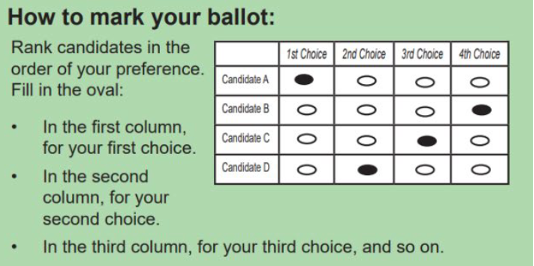
Next, the choices are tabulated. If any candidate reaches 50% plus-one of the “1st Choice” vote, they win. If nobody reaches 50%, the candidate with the fewest 1st Choice votes is eliminated, but the 2nd Choice votes from voters choosing the eliminated candidate goes back into the tabulation, counting as 1st Choice votes.
In the next round, if someone gets 50% they win, but if nobody gets 50% the candidate with the lowest total of 1st Choice votes is again eliminated. As before, the 2nd Choice choices from voters who gave the eliminated candidate their 1st Choice would go back into the tabulation as 1st Choice votes.
In the case of a race with 4 candidates, if the 3rd and 4th-place candidates are both eliminated, the next round should yield 1 candidate out of the 2 remaining with a majority, and that candidate wins.
In Longmont’s system, all 3 Council Ward races and the Mayor’s race are single-winner contests. These contests could be settled using currently available RCV digital systems.
However, the 2025 at-large race had two open seats and voters could vote for 2 candidates. There are other types of RCV for multiple-winner districts like this, but equipment isn’t certified for these types of races yet in Colorado. It’s possible that a race like this might still be conducted in Longmont using the old plurality voting method, at least until multiple-winner RCV systems are certified. The ordinance on the July 28 Longmont agenda says “any contest may be conducted using the plurality voting method” if equipment is not certified for things like multi-winner races.
What If Only 1 or 2 Candidates are in a Race?
If there are only 1 or 2 candidates in a race, one candidate will win without needing RCV.
In 2025, only two candidates ran for Longmont’s Ward 2, and one got 54% so they won. 4 candidates ran for Mayor, so there would have been a RCV election like the graphic above. However, there were 6 candidates running for 2 open at-large seats, so this one might have been settled using plurality voting.
In 2023, 4 candidates ran for Ward 3, 3 candidates for Mayor, 3 candidates for Ward 1, and 3 candidates for one open at-large seat. These all could have been settled with currently available RCV systems.
Financial Aspects
RCV elections are tabulated using different digital systems than plurality elections, since they’re not just counting raw votes, and they have to do things like eliminate candidates and transfer choices to other candidates. Per the July 14 Longmont Council agenda packet, there could be additional expenses of $100,000 for increased costs of using RCV, and $50,000 for a voter education program showing people how to use RCV.
Proponent Points
RCV allows races with 3 or more candidates to produce a winner getting a simple majority (50% plus one) without going to a physical runoff election.
The Longmont Council agenda packet says RCV is a “more expressive” option for voters who might support more than one candidate, since they can cast votes for extra candidates they like with their 2nd, 3rd, or 4th-choice votes instead of only being able to vote for one person.
RCV might open races to more candidates or more types of candidates.
There would be voter education programs to show people how to use a new system before they vote.
Links to More Information
RCV For Longmont website: https://www.rcvforlongmont.org/
Longmont City Council agenda packets: https://longmont.primegov.com/public/portal
Video on RCV: https://www.youtube.com/watch?v=l8XOZJkozfI&t=11s
City of Longmont Ballot Question 3D: Council Term Stagger
Longmont City Council put this measure on the 2026 ballot on July 28.
This ballot measure would amend the Longmont City Charter to change Longmont City Council “at-large” elections (covering the entire city, not just single wards) by eventually running races for all three at-large seats in the same year. Currently, Longmont uses a “stagger” system that has one election for one at-large seat, but two years later holds an election for two seats on the same ballot.
Also, elections for all three Council seats elected from wards would be held in one year. Once again, there are elections for one ward seat in one year, then elections for two ward seats two years later.
To accomplish this change, the at-large winner in 2027 would only win a two-year term, and the winner from Ward 2 in 2029 would only win a two-year term. Starting in 2029, there would be an at-large race for all three seats in the same year, and this would happen again every four years. Starting in 2031, there would be races for all three ward-based seats in the same year, and this would happen again every four years. The Mayor’s race is not affected by this ballot measure.
Per the Longmont ordinance for this ballot measure from July 28, making this change would be “less confusing” for Longmont voters who must figure out who they’re voting for in a given election year.
Also, the ordinance says having at-large elections in one year and then ward elections two years later would “preserve the purpose and intent of the stagger.” In essence, there would not be a complete turnover of Council every two years, as half the seats (not counting the Mayor) would be up for election or re-election in one year, then the other half would be up two years later.
This ballot measure would not take effect if the ranked-choice voting ballot measure also proposed for 2026 fails.
Proponent Points
Making this change would, as the ordinance suggests, make elections less confusing for voters because they’d know which seats are up for election or re-election in any given year.
Changing the at-large elections to the same year could allow for electing all three seats in a ranked choice voting election, if a digital RCV system for multiple-winner races is approved for use.
Making the change would preserve the intent of Longmont’s system of staggering Council terms so there isn’t large turnover every two years
Opponent Points
Candidates running at-large in 2027 and for Ward 2 in 2029 would only get two-year terms, when under the current system they’d win four-year terms. Running for office is time-consuming and stressful, and these winners might need to launch a campaign once again in just two years if they want to run for re-election.
Links to More Information
RCV Longmont policy brief touches on proportional RCV and multi-winner RCV contests: https://www.rcvforlongmont.org/why-rcv
July 28 Council agenda packet, which has the most recent draft ballot language: https://longmont.primegov.com/public/portal
City of Louisville Ballot Issue 2B: Historic Preservation Tax Extension
This ballot measure would extend an existing 0.125% City of Louisville historic preservation sales and use tax for 10 years. The first full-year revenue collection is projected to be about $1.5 million. This extension would run from Jan. 1, 2029, until Dec. 31, 2038.
Louisville voters passed its first 0.125% historic preservation tax in 2008, and the revenue was to be spent specifically for projects in the Old Town Louisville district. The tax was extended in 2017, and it allowed for funding to the Louisville Museum Campus and projects outside of Old Town with Council approval.
The 2026 ballot measure would keep the same tax rate, but some of the allowed uses would change, as follows:
Increasing the percentage of revenue going to the Louisville Museum Campus from its current 20% to 30%
Allows funding to go toward City programs and capital projects that promote and preserve the City’s history and cultural heritage.
Proponent Points
The historic preservation tax has helped Downtown Louisville remain a pleasant place in which to visit and do business
This measure is just a tax extension, so tax rates won’t go up
Since it’s a sales tax, tourists and visitors to Louisville pay some of the revenue
Opponent Points
Some people might want to keep the money instead of continuing the tax
Some people might not believe historic preservation is a public need
Links to More Information
Ordinance 1928 text: https://louisvilleco.portal.civicclerk.com/event/31/files/attachment/4064
City of Louisville Historic Preservation webpage: https://www.louisvilleco.gov/local-government/government/departments/planning/historic-preservation
Historic Preservation Master Plan: https://www.louisvilleco.gov/media/zlqouqmj/preservation-master-plan.pdf
Historic Preservation Commission: https://www.louisvilleco.gov/departments/city-clerks-office/boards-commissions/historic-preservation-commission/
City of Louisville Ballot Question 2C: Allowable Reasons for Executive Session
This ballot measure would amend Louisville’s City Charter to align city requirements around topics that are allowable for going into executive session with State of Colorado law. In executive session, a governing body can meet in an area not accessible to the public, but it must record the meeting and cannot pass ordinances or legislation without public access.
Currently, Louisville’s Charter lists the following allowable topics for executive session (abbreviated for simplicity):
If information is required to be kept confidential
Sensitive personnel matters
Considerations of water rights or real property acquisition
Consultation with attorneys on pending litigation
This ballot measure would allow Louisville’s City Council to enter into executive sessions for any reason allowable under Colorado Revised Statutes § 24-6-401 and into following relevant CRS sections.
To learn more about what’s allowed under state law, visit this link but scroll way down to section 3): https://law.justia.com/codes/colorado/title-24/administration/article-6/part-4/section-24-6-402/
The City of Boulder passed a similar measure in 2024 with Question 2D. It added several new allowable reasons for executive sessions.
Proponent Points
This ballot measure would align Louisville with state law, like other cities have done
It may be important or even beneficial for Council to discuss certain issues in private
There are laws around executive sessions that prevent a governing body from taking official action in executive session, and require the body to record the session
Opponent Points
Council does the public’s business, and it should be conducted in public to the greatest extent possible
Some people might believe Louisville’s existing allowances for executive sessions are good enough, and they don’t need to be expanded
Links to More Information
Ordinance 1929 text: https://louisvilleco.portal.civicclerk.com/event/31/files/attachment/4078
City of Louisville Ballot Question 2D: Mayor and Council Swearing-in Date
This ballot measure would amend Louisville’s City Charter section about when the Mayor of Louisville and City Council members take office after an election.
The current Charter section says members will get sworn in at the first regular Council meeting “after their election.” This ballot measure would change the swearing-in until the first regular Council meeting after “certification of the election results.”
Per Ordinance 1930 language, this change might be necessary because “it is increasingly taking longer for election results to be certified for reasons related to increased voter turnout, the use of mail ballots, and requirements relating to military and overseas voting.”
Proponent Points
This would clarify that members should not be sworn in until election results are certified.
It’s prudent to make sure members have certified election results before being sworn in.
A Louisville agenda packet said “11 of 17 survey municipalities” wait until after certification, so it’s already common practice if not universal.
Links to More Information
Ordinance 1930 text: https://louisvilleco.portal.civicclerk.com/event/31/files/attachment/4068
City of Louisville Ballot Question 2E: Increased Initiative Petition Signature Requirement
This ballot measure would amend the Louisville City Charter to increase the requirements for petition signatures on citizen initiatives from its current 5% of Louisville registered electors to 7.5% of registered electors.
The measure would also increase signature requirements for referendums from its current 2.5% of registered electors to 5% of registered electors. Referendums are different from initiatives in that they are citizen challenges to ordinances that City Council adopts.
Per a Louisville Council agenda packet, here is how the numbers of required petition signatures would change if this measure passes. Of course, the number of registered electors could change any year into the future, so these numbers might look different in other years.
| Current Signatures Required |
Proposed Signatures required |
Difference | |
|---|---|---|---|
| Initiative | 810 (5%) | 1215 (7.5%) | 405 |
| Referendum | 405 (2.5%) | 810 (5%) | 405 |
Proponent Points
Current signature requirements may be lower than some other municipalities
Some people might believe it’s currently too easy to get a measure on the ballot
Opponent Points
Petitioning takes time and potentially money, so this ballot measure might impose new burdens on people who want to exercise their right to initiative or referendum
Links to More Information
Text of Ordinance 1931: https://louisvilleco.portal.civicclerk.com/event/31/files/attachment/4070
City of Louisville Ballot Question 2F: Accessible Meeting Locations
This ballot measure would amend the Louisville City Charter to allow public meetings to be held in non-public buildings. It would not “require” meetings to be held in non-public buildings, it just allows the option.
Today, the Charter says all public meetings “shall occur in public buildings and public facilities.” The ballot measure would add a clause saying “or in such other location approved by the public body.”
This measure is currently being deliberated by Louisville City Council under Ordinance 1932. The ordinance language notes that the current requirements to only use public buildings “has restricted public meetings from being held in other accessible venues and has made it difficult for City Council and other public bodies to have joint meetings in neighboring municipalities.”
Proponent Points
This would expand the options for meeting locations, which might lead to convenience for participants and attendees.
Links to More Information
Ordinance 1932 text: https://louisvilleco.portal.civicclerk.com/event/31/files/attachment/4079
City of Louisville Ballot Question 2G: Review and Comment Period for Initiatives
This ballot measure would amend the Louisville City Charter, basically by requiring proponents of a citizen initiative to submit language to the City Manager for review at a public hearing.
For some key points:
For any citizen-initiated ordinance or Charter amendment, the proponents would need to submit initiative text to the City Manager
Within 10 days of getting the initiative language, the City Manager (or other staff) would need to provide comments to proponents at a public hearing
The City Manager would not have the authority to mandate changes to the initiative, but could provide suggestions that proponents could adopt or not adopt.
This ballot measure was suggested by City of Louisville staff, and could be put on the ballot through a 2/3 vote of City Council. It is not a citizen initiative. It was presented as Ordinance 1933.
Proponent Points
It is possible for initiative proponents to submit language for a ballot measure with mistakes or questionable sections. A review and comment period might lead to a better or more accurate ballot measure, depending on the quality of the comments.
There is a difference between submitting “inaccurate” information and submitting “misleading” information. Whether information is intentionally misleading or not intentionally so, a review and comment hearing might help clarify confusing information for the voters.
Even with a review and comment hearing, initiative proponents would not have to amend their initiative under this ballot measure, unless they agree it’s the right thing to do.
Opponent Points
This Charter amendment might place an additional burden on the proponents, by requiring them to spend 10 days getting ready for a public hearing when they don’t currently need to do this.
A public hearing could get political, activists might mobilize to pack the meeting, and media coverage might accentuate controversy over what an initiative technically seeks to do. This could be either advantageous or disadvantageous to either side of an issue.
Links to More Information
Ordinance 1933 second reading text: https://louisvilleco.portal.civicclerk.com/event/31/files/attachment/4072
City of Louisville Ballot Question 2H: Charter Language Amendments
This ballot measure would change language in several sections of Louisville’s City Charter in the following ways:
Section 3-3: Would change “his or her” to “their”
Section 4-3: Would change “his or her” to “their”
Section 4-11: Would change a statement that notices about non-emergency ordinances must be available in “city offices” to that they must be available at “the City Clerk’s office and on the City website.”
Section 4-14: Would change a statement that notices about ordinances that adopt a code by reference must be available in “city offices” to that they must be available at “the City Clerk’s office and on the City website.”
Section 4-16: Would change references to “citizens” in three parts of this section to “members of the public.”
Section 5-3: Would change “his or her” to “their”
Section 5-5: In 2 parts of this section, it would change references to “citizens” to “members of the public.” It would also change a reference to “on television” to “virtually.”
Section 5-9: In 4 parts of this section, it either changes “his or her” to “their,” or “he or she is” to “they are.”
Section 5-11: In one section it changes “his or her” to “their,” and in another changes “he or she” to “they”
Section 5-12: Would change “he or she has” to “they have”
Section 5-18: Would change “his or her” to “their”
Proponent Points:
This Charter change would increase inclusivity in Charter language for nonbinary people and people who may not technically be citizens
It modernizes the Charter by changing TV to “virtual”
It’s specific about where public notices must be available
Links to More Info:
Louisville Council Second Reading document: https://louisvilleco.portal.civicclerk.com/event/31/files/attachment/4080
Proposed Municipality of Niwot Questions 300–306: Incorporation
Currently, Niwot is not an incorporated city – it's an unincorporated area within Boulder County. A package of ballot measures that are on the 2026 ballot could decide if Niwot will incorporate, along with what types of taxes and debt authorization will fund or finance town operations. Much of the information below is from a Niwot Home Rule Incorporation proponent website: https://www.niwot.town/ and an opponent site called Neighbors For Niwot: https://neighborsforniwot.org/
There is a list of the ballot questions and issues at the link to follow, but below are some very short descriptions of the issues and questions: https://niwotelection.org/ballot
Question 300, Incorporation: Shall Niwot be incorporated as a municipality?
Question 301, Home Rule Charter Commission: Shall a Home Rule Charter Commission be formed ... for the Proposed Municipality of Niwot?
Charter Commission Election: Following Question 301 on the ballot is a list all the people running for Home Rule Charter Commission. Voters can choose up to 9 people.
Issue 302, Sales and Use Tax:
If approved, Niwot would impose a 2.5% local sales tax starting January 1, 2028. Groceries are exempt. The town council would set specific exemptions by ordinance. The use tax applies to construction materials and other tangible goods stored or consumed in Niwot. The estimated first-year revenue would be about $2.8 million.
Issue 303, Property Tax:
If approved, Niwot would impose a 4-mill property tax levy for town operations and maintenance. For a home assessed at $700,000, this is approximately $188 per year. The estimated first-year revenue would be about $900,000.
Issue 304, Marijuana Sales Tax:
If approved, Niwot would impose a 3% additional sales tax on retail marijuana, if any retail marijuana businesses operate in Niwot. This is a standard authorization that most Colorado municipalities include. The estimated first-year revenue would be about $60,000.
Issue 305, TABOR De-Brucing:
If approved, Niwot would be able to keep and spend all revenue it collects, including grants, fees, and tax revenue, without being required to refund money under TABOR’s revenue cap. Nearly every Colorado municipality has approved this measure. Without it, the town could be forced to return revenue even if services are underfunded.
Issue 306, Debt Authorization:
If approved, Niwot would have the authority to issue up to $15 million in revenue bonds for road and infrastructure improvements, repaid from sales tax revenue. The maximum total repayment cost would be $28 million. This funds the repair and improvement of Niwot’s streets, roads, bridges, drainage, and sidewalks.
Boundaries
The incorporation petition has the proposed boundaries for a City of Niwot, and they can be found on about pages 12-18 of this petition: https://www.niwot.town/assets/petition_for_incorporation_niwot_2026%20.pdf
Proponent Points
Niwot may benefit from infrastructure improvements, and new revenue from sales and property taxes should help get projects done
Right now, Boulder County is the highest-level governing authority for this unincorporated area (though there is a Niwot Local Improvement District to advise the county), and incorporating would help Niwot make decisions for Niwot
Boulder County may have adopted policies that some Niwot residents don’t agree with, and proponents claim the County is far behind on road repair and maintenance
Opponent Points
Incorporating in the manner proposed would impose several new taxes, and the property taxes in particular might increase the cost of living or doing business in Niwot
With incorporation comes the responsibility of creating and managing a new government, which might entail some extra work or other difficulties, plus uncertainties like if the approved tax structure will meet responsibilities or if Niwot will need to raise taxes or revenue into the future
Incorporating might mean Niwot would lose some land use or other protections currently provided by Boulder County governance
Links to More Information
Niwot Incorporation (proponents) website: https://www.niwot.town/
Neighbors For Niwot (opponents) website: https://neighborsforniwot.org/
Niwot ballot content: https://niwotelection.org/ballot
KGNU story on incorporation: https://kgnu.org/some-niwot-residents-want-to-incorporate-the-town-heres-what-that-would-mean/
Niwot Local Improvement District: https://bouldercounty.gov/government/boards-and-commissions/niwot-local-improvement-district/
Special district measures
Front Range Passenger Rail District Ballot Issue 7A: Front Range Rail Expansion Tax
NOTE: The Front Range Passenger Rail District Board decided to put this issue on the ballot on Aug. 28.
This ballot measure asks for a .333% sales and use tax for the Front Range Passenger Rail District, which is basically an area from Ft. Collins to Pueblo along the I-25 corridor. The measure would be expected to generate about $295 million per year. The revenue would help eventually expand Front Range Rail from Denver to Pueblo, and would help increase trip frequency from three daily round trips to 10 trips.
The Colorado Democratic Party and Boulder County Democratic Party have both formally ENDORSED this ballot measure.
Super-brief history
Many Boulder County residents expected commuter rail service between Longmont and Denver, including through Boulder, when voting on the RTD FasTracks ballot measure in 2004.
The Northwest Rail line hasn’t happened yet, but a coalition of groups worked together to create a “Joint Service” agreement, which currently could deliver 3 round trips daily of rail between Ft. Collins and Denver by 2029 without a tax increase. Funding includes money from a RTD FasTracks savings account and revenue from two State of Colorado bills.
The Colorado state legislature approved the Front Range Passenger Rail District in 2021, which established a district along the I-25 corridor for eventual passenger rail from Ft. Collins to Pueblo.
What happens if this ballot measure passes or fails?
If Issue 7A passes, the revenue is intended to ultimately increase trip frequency to up to 10 round trips per day, and would help build the system out all the way to Pueblo. The new Front Range Rail service was recently branded the “Colorado Connector,” or CoCo for short.
If the ballot measure fails, the Front Range Passenger Rail District and Joint Service partners have said there is still enough funding to get 3 round trips of rail daily from Ft. Collins to Denver by 2029.
Proponent Points
This new rail service would allow more people to travel longer distances car-free
The tax revenue would allow for more trip frequency and would cover greater distances than just what the Joint Service agreement would provide
Rail could reduce auto traffic, auto congestion, or greenhouse gas emissions.
Rail tends to be a nice ride, compared to buses, and riders don’t need to focus on a road like they would while driving
Rail may have economic benefits, like job creation or attractiveness to businesses wanting to locate here
Links to More Information
Resolution text for putting the measure on the ballot: https://www.frprdistrict.com/_files/ugd/3f188e_81fe6114861f41efa56fc00d0d69a3cc.pdf
Basic fact sheet on Joint Service: https://www.codot.gov/programs/transitandrail/assets/joint-service-fact-sheet_accessible.pdf
Colorado Connector: https://coloradoconnector.com/
Denver Post story on the 2026 ballot measure: https://www.denverpost.com/2026/07/20/front-range-train-on-track-to-run-between-denver-fort-collins-in-2029/
Eldorado Springs Public Improvement District Ballot Issue 6A: Wastewater Plant
Most basic points:
This measure would authorize up to $1,000,000 in new district debt.
The financing would be used for wastewater plant improvements
This measure does not include a proposed tax increase
Maximum repayment would be up to $1,440,000
Sombrero Ranch Public Improvement District Ballot Issue 6B: Road Improvements
Most basic points:
This measure would implement an ad valorem property tax of up to 14.47 mills
The revenue would be used for road resurfacing and other road improvements
The district would be authorized to bond for up to $3,500,000
Revenue for the first full year would be $185,000
Summerlin Public Improvement District Ballot Issue 6C: Road Improvements
Most basic points:
Passing 6C would implement an ad valorem property tax of up to 17.34 mills
The revenue would be used for road resurfacing and other road improvements in the district
The district would be authorized to bond for up to $1,250,000
Aggregate district taxes would be increased by $60,000 in the first full year.
Timberline Fire Protection District Ballot Issue 7B: Fire Safety Improvements
Most basic points:
Passing 7B would implement a new property tax levy of 6.0 mills.
The revenue would fund firefighting needs including “but not limited to” hiring firefighters, wildfire mitigation, and general operations.
It’s designed to raise $1.2 million in the first full year.
Allenspark Fire Protection District Ballot Issue 7C: Fire Safety Improvements
Most basic points:
Passing 7C would implement a new 5.3 mill property tax rate increase
Revenue would be used for district needs, including “but not limited to”: expanding staffing; expanding water resources; updating firefighting and medical equipment; rebuilding financial reserves; and addressing deferred facility maintenance.
Tax revenue to the district would increase by $331,000 in the first full year.